
01
Find answers in your company's own knowledge
A scoped assistant can find information in guides, previous cases and internal documents, and show the sources behind its answer.
The employee can verify both the answer and its source.


AI that gets a clear role
We start with the task you recognise – not with the technology. Then we build the solution that solves the task responsibly.
From answer to action
The word AI covers very different solutions. Here is the difference, explained without jargon.
Answers
Answers based on general knowledge. It doesn't know your prices, orders or rules, and it cannot act inside your systems.
Knows the business
Answers based on your own documents, guides and product data. We decide which sources it may use, so answers can be traced back.
Carries out tasks
Can look up, check and prepare actions in your systems according to clear rules – for example finding an order or gathering shipment status.
Becomes a product
Here AI is only a subset. Data, automation, rules and user interface matter just as much for the solution to work in production.
Concrete solutions
For each solution we agree what AI may do, what the employee approves, and which data is used.
01
A scoped assistant can find information in guides, previous cases and internal documents, and show the sources behind its answer.
The employee can verify both the answer and its source.
02
AI can help find missing data, explain deviations and prepare actions relating to products, prices and orders.
Changes are reviewed before they are written back to the system.
03
An agent can find the order, gather the information and prepare the next action in a system such as Shipmondo.
The action is only carried out after human approval.
Other scoped tasks
AI as part of a product
Money Leak is an example of a larger digital product where data analysis, deterministic rules, prioritised cases and Leak Analyst™ work together. The AI is not a loose chatbot, but a controlled layer that helps users understand existing findings.
See the Money Leak case Leak Analyst™
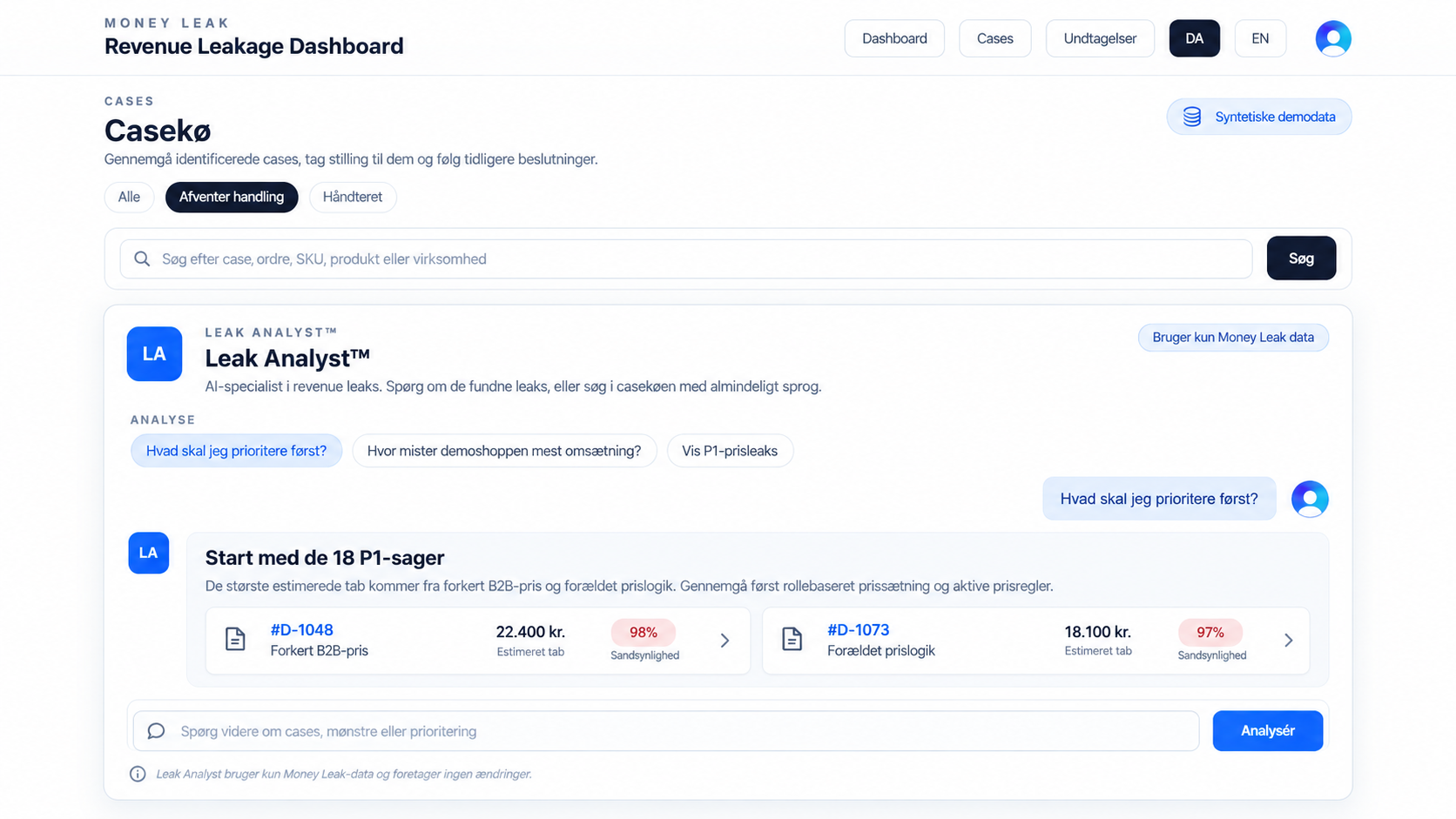
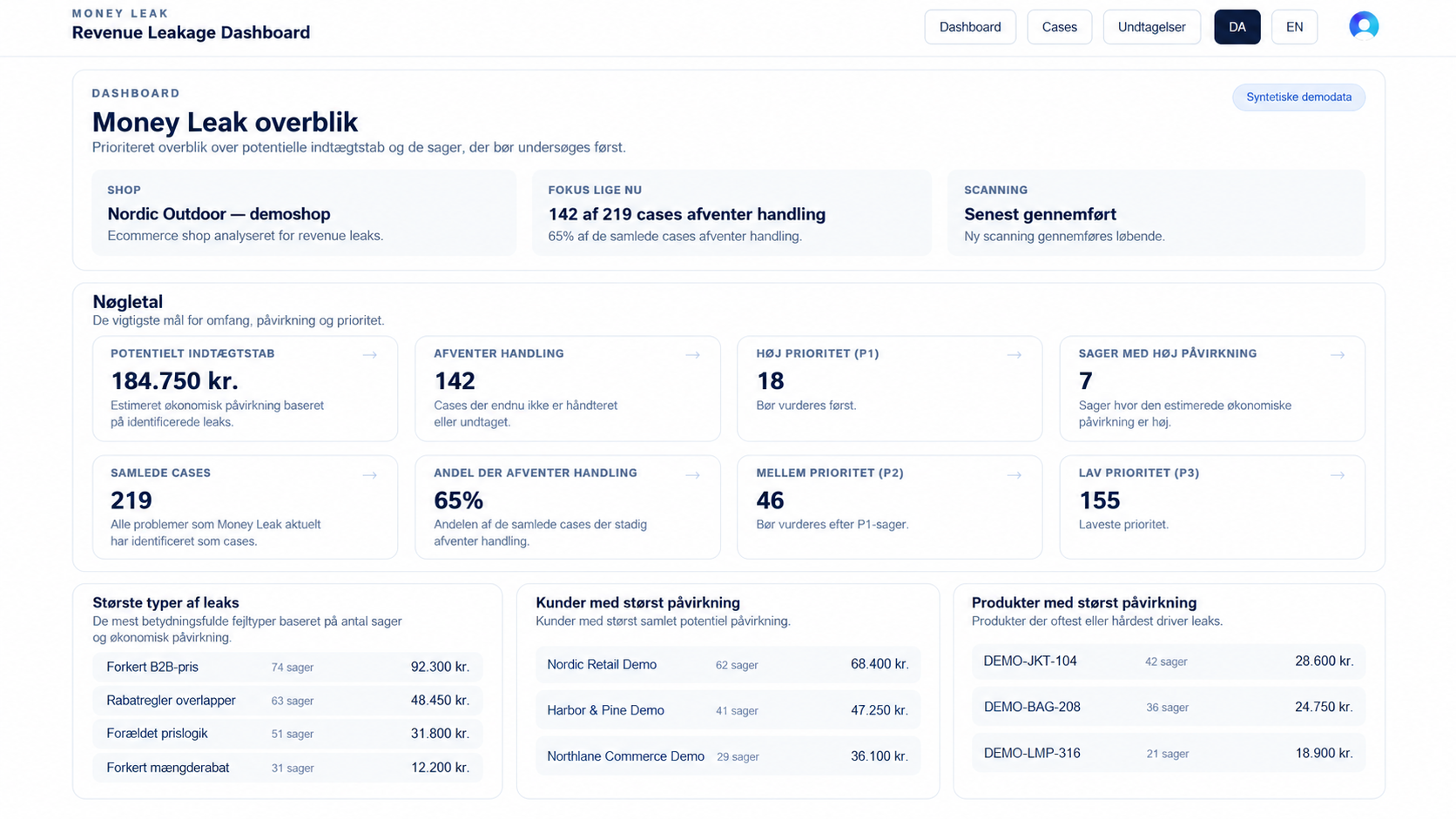
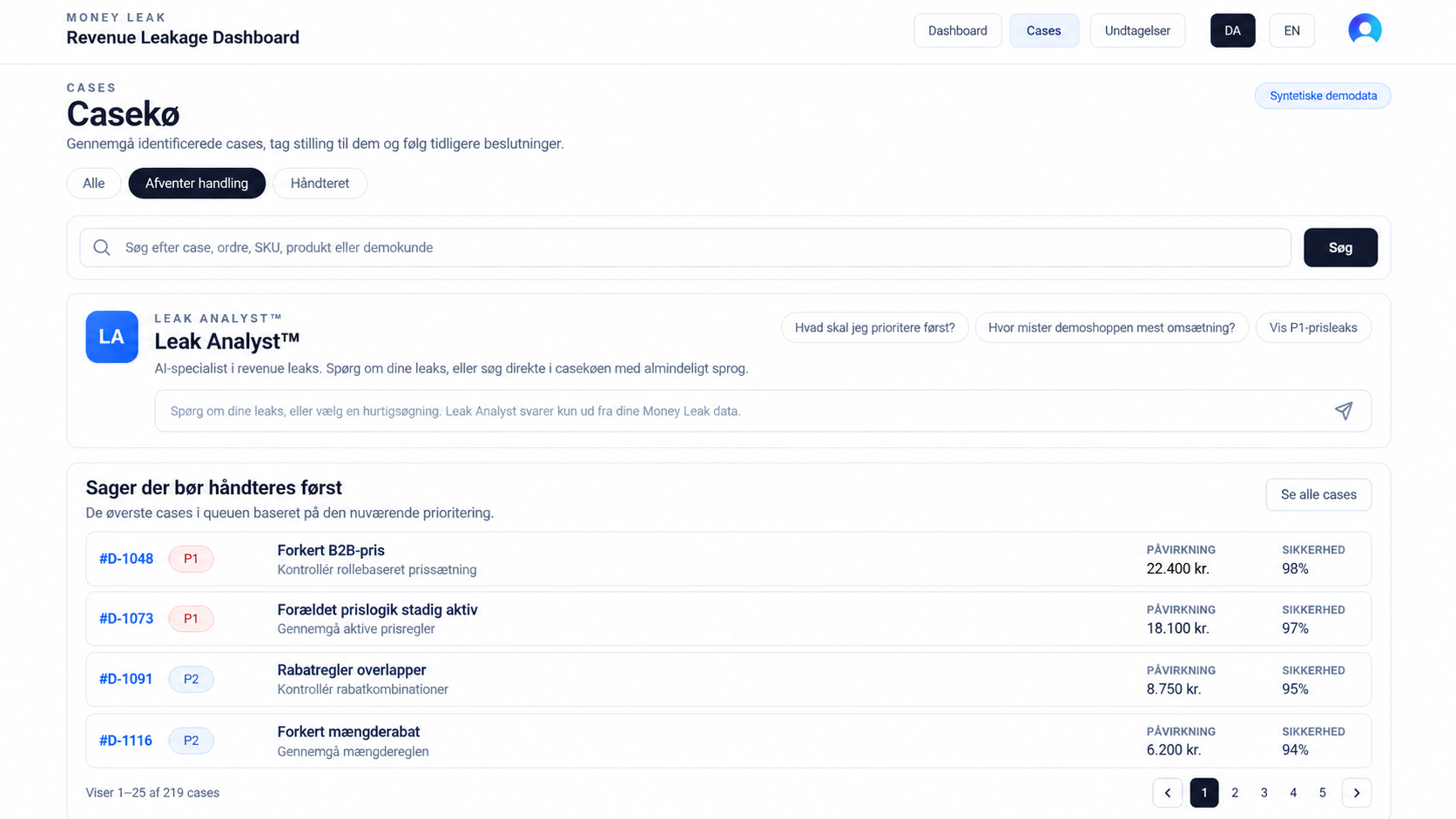
Product visuals are shown with synthetic demo data.
A concrete agent example
With access to a tool, an AI agent can, for example, find an order, check shipping information and prepare the next step. Rules and approvals determine what the agent may do.
This is an example of a possible solution – not a delivered Shipmondo customer case.


How we build an AI solution
We review the task, the systems and the rules that actually apply in practice.
We describe the solution, the scope and what a human should still approve.
We build in small steps and test on real data before anything goes live.
We help with training, adjustments and follow-up once it is in use.
Security and control
When a solution gets access to orders, customer data or internal documents, we decide on access, data processing, approvals and error handling. The goal is not to automate as much as possible, but to automate the right things.
The solution only gets access to what the task requires – and nothing more.
We agree which data is processed, where it is stored and for how long.
Actions with consequences are placed behind a human approval.
We build in checks, logging and a clear plan for what happens when something fails.
Next step
You do not need a finished solution or to know whether the task requires AI. Describe the problem, the workflow or the idea – and we will have a first conversation about what is realistically possible.